Measured. Isolated. Controlled.
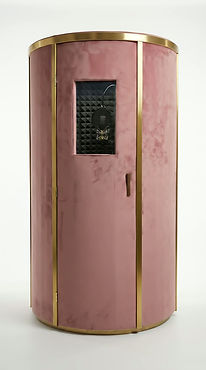
Engineered as a fully isolated, internally treated recording space, the VB-1 combines floating room-within-room construction and controlled acoustic geometry to deliver predictable, high-isolation performance.

Engineered for Isolation and Accuracy
The performance of the VB-1 is the result of deliberate structural engineering, acoustic modelling, and precision manufacturing. Every joint, air gap, seal, and material interface has been specified to minimise vibration transfer, eliminate structural noise, and create a controlled internal acoustic environment.
The booth is not simply lined with absorption; it is constructed as a mechanically isolated, internally treated recording space designed to deliver measurable isolation and predictable acoustic behaviour.
Room-Within-Room Construction
The VB-1 achieves maximum noise isolation through a true room-within-a-room construction, in which the inner enclosure and the outer structural shell have no rigid mechanical connection. The internal room effectively “floats” within the external shell, supported and sealed using high-quality flexible acoustic materials. These materials provide structural support while simultaneously preventing direct vibration transfer and unwanted air movement between the two layers.
Inner and outer wall sections are separated by a 10mm air gap, further reducing sound transmission by interrupting direct structural coupling. By eliminating rigid mechanical bridges between the inner and outer structures, the booth significantly reduces the transmission of airborne and structure-borne sound, helping to prevent both ingress and egress of noise.

Structural Silence and Mechanical Integrity
All timber mating surfaces throughout the booth are both glued and screwed together, rather than simply fastened. This method ensures maximum strength and long-term stability while preventing micro-movement between components that could otherwise introduce creaks, rattles, or mechanical noise. The result is structural silence under normal use and over time.
Due to the modular nature of the design, the VB-1 is assembled on site. During assembly, all joined components either compress fabric between mating surfaces or incorporate additional acoustic gaskets to prevent movement-induced noise and eliminate potential vibration paths. The modular sections are screwed or bolted together in a way that allows the booth to be dismantled without damage if relocation or reconfiguration is required in the future.
Consistency across builds is ensured through CAD design and CNC-machined components, allowing precise tolerances and repeatable quality. Every structural element is manufactured to exact specifications to ensure reliable performance in each unit.
Controlled Internal Acoustics
The internal acoustic environment of the VB-1 is carefully controlled through geometry, absorption, and diffusion. Acoustic treatment is provided using eight individual acoustic wall panels and one high-density pyramid foam diffuser panel. These panels are linked together to form a permanent installation but can be removed or reconfigured to suit individual preferences or recording requirements. The ceiling itself functions as a ninth acoustic panel, containing 50mm thick Rockwool insulation and finished with black Camira Cara fabric. This permanent ceiling panel contributes significantly to vertical absorption and overall acoustic consistency.
The inner walls are not cylindrical; instead, they are constructed from flat panels of varying widths. This intentional variation prevents sound focusing and reduces the likelihood of standing waves forming between parallel surfaces.
Importantly, the geometry of these structural wall panels does not align with the layout of the eight removable acoustic wall panels. This mismatch creates voids of varying depth and shape behind the acoustic treatment. These irregular cavities assist in diffusing mid and lower frequency energy, contributing to a more balanced and controlled internal response.
The extensive multilayer floor construction also contributes to acoustic control. It is finished with an 11mm luxury medium cut pile carpet laid over a 10mm PU underlay, providing comfort underfoot while offering additional absorption and reduction of internal reflections.
Externally, the outer fabric is upholstered over 12.5mm acoustic foam, giving a soft-touch finish while visually softening hard surfaces and edges. This additional foam layer also contributes to reducing reflections in the wider studio environment in which the booth is placed.


Airtight Sealing and Flanking Noise Control
The door assembly plays a critical role in maintaining isolation performance. Rotating the door handle activates a shoot-bolt mechanism that extends and retracts bolts at the top and bottom of the door, drawing it tightly into position and creating a fully sealed closure. The substantial door seals are manufactured from Pysorb-s acoustic foam, providing both compression and acoustic damping around the perimeter.
In addition to their visual function, the long vertical external trims also act as secondary sealing elements between modular sections of the booth. These trims help close potential gaps between joined components, further reducing flanking noise paths.
Cable access and ventilation openings are carefully integrated to avoid compromising performance. The apertures in the base trim are positioned at 90 degrees to each other and are wide enough to allow the passage of commonly terminated audio cables. Three access points can be positioned relative to the door orientation, allowing cables to enter from multiple directions or even pass beneath the booth entirely to maintain tidy studio cable management. These low-level slots also serve as the primary air intake points, drawing cooler air from the lowest point in the surrounding room.

Decibel Reduction Across Frequencies
The VB-1 has been tested to quantify its sound isolation performance across key frequencies. Using controlled single-frequency tones, measurements were taken inside and outside the booth to determine the level of noise reduction it provides. The table below shows the decibel difference at each frequency, highlighting the booth’s ability to minimise sound transmission and provide a quiet, predictable recording environment.
Frequency | Internal dB | External dB | dB Reduction |
|---|---|---|---|
4000 | 95dB | 32.5 | 62.5 |
1000 | 95dB | 46.5 | 48.5 |
500 | 95dB | 48.8 | 46.2 |
200 | 95dB | 42.4 | 52.6 |
C weighted, 95dB internal reference, 1 metre external measurement, studio environment.
Testing environment included typical residential studio ambient noise. Results may be greater in controlled lab conditions.
A key feature of the VB-1 is its ability to minimise external noise entering inside. Traffic, passing lorries, distant conversations and general studio activity are significantly reduced by its room-within-a-room construction, floating inner structure and airtight sealing system. Even low-frequency rumble is controlled, helping maintain a clean recording signal. This level of isolation also allows others in the studio to speak at a normal level during takes — removing the need for complete silence once record is pressed.